
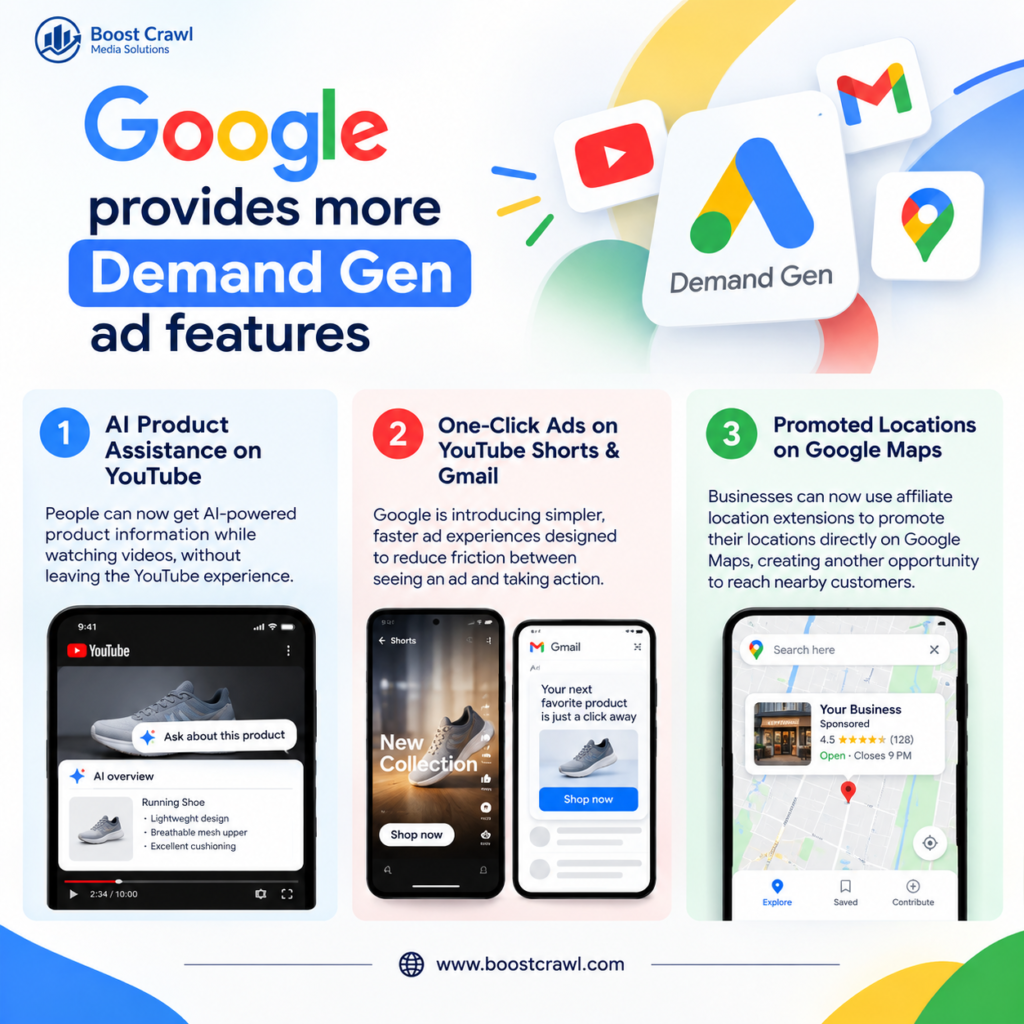
Google has introduced several new Demand Gen advertising features that could change how brands connect with customers across YouTube, Gmail and Google Maps. The latest updates focus on three areas: AI-powered product assistance on YouTube, simpler one-click image ads on YouTube Shorts and Gmail, and promoted business locations through affiliate location extensions on Google Maps.
For advertisers, these changes are important because Google is bringing product discovery, engagement and local intent closer together. Instead of treating an advertisement as a simple message that sends people to another website, the new experience is designed to help users discover products, understand them and take action within the platforms they are already using.
For businesses in India, especially local and growing brands, the updates also show why Google Ads strategy is becoming more than just selecting keywords and a budget. Creative format, audience signals, product information, location targeting and the customer journey all need to work together.
1. AI-Powered Product Assistance Comes to YouTube
The first major update is the introduction of AI-powered product assistance alongside product feeds on YouTube. The idea is to make product discovery more interactive while people are watching videos.
According to Google’s announcement, viewers will be able to ask questions about products shown in a video without leaving the YouTube viewing experience. The Ask YouTube experience can provide additional information about products, helping users learn more while they are still engaged with the content.
This is significant for advertisers because video advertising is increasingly becoming part of the product research process. A potential customer may see a product in a video, become interested and immediately want to know about its features, use cases, price or suitability. AI assistance can help shorten the gap between that initial interest and product research.
For brands, this makes accurate product information increasingly important. Product feeds, landing pages, creative messaging and offers should communicate the same core information. If an advertisement creates one expectation and the product page creates another, the customer journey can become confusing.
Businesses should therefore think about their YouTube advertising strategy from the customer’s perspective. The goal is not simply to generate views. The goal is to make the next step easier for someone who is already interested.
2. One-Click Image Ads on YouTube Shorts and Gmail
Google is also rolling out simpler, faster ad experiences on YouTube Shorts and Gmail.
On YouTube Shorts, advertisers can upload 9:16 full-bleed image ads designed for the vertical Shorts environment. The format is intended to provide a more direct response path for viewers.
Gmail is another important part of the update. Google says advertisers adding Gmail to their Demand Gen campaigns have, on average, seen image creatives achieve a 40% increase in conversions at the same return on investment. This is a Google-reported average, so individual campaign performance can vary depending on the advertiser, audience, creative, offer and other factors.
The bigger lesson for marketers is that reducing friction matters. When someone sees an advertisement, every unnecessary step between interest and action can reduce the chance of conversion. Simpler experiences can make it easier for users to move from discovering an offer to taking action.
This also puts more pressure on the creative itself. A vertical image advertisement has very little time to communicate its message. Businesses need a clear headline, recognizable branding, strong visual hierarchy and one obvious action.
For example, a local service business could use a simple creative focused on one offer instead of putting every service, feature and benefit into a single image. A real estate company might promote one property or one specific project. A clinic could highlight one service and one booking action. A D2C brand could focus on one product and one compelling reason to consider it.
3. Promoted Locations on Google Maps
The third update involves affiliate location extensions in Google Maps. This gives businesses another way to promote their locations within the map environment.
Maps is especially relevant because users often have strong local intent when they search there. Someone looking for a restaurant, showroom, clinic, retail store or service provider may already be close to making a decision.
Promoted locations can therefore become another part of a local advertising strategy. Businesses should make sure their location information is accurate and consistent, including business name, address, opening hours and other relevant details.
The update also highlights the importance of connecting advertising with real-world customer journeys. A customer might discover a business through a YouTube video, see another promotion in Gmail and later search for its location on Google Maps. Advertising platforms are increasingly becoming connected parts of one customer journey rather than completely separate channels.
What These Demand Gen Changes Mean for Advertisers
The common theme across all three updates is customer intent.
YouTube helps with discovery and product research. Shorts and Gmail can provide faster response paths. Google Maps can support local discovery and physical visits.
This means advertisers should avoid thinking about Demand Gen as simply another campaign type. It can be part of a broader customer journey.
A useful approach is to divide the campaign strategy into three stages.
At the first stage, use strong visual content to create awareness and interest.
At the second stage, provide enough product or service information to help the customer evaluate the offer.
At the third stage, make the action simple, whether that means purchasing, submitting a lead form, calling a business or visiting a location.
Creative testing will also become increasingly important. Instead of creating one advertisement and running it for months, businesses can test different hooks, images, offers and calls to action. Performance data can then be used to identify which messages generate meaningful business results.
How Boost Crawl Media Solutions Can Help Businesses Grow
Boost Crawl Media Solutions helps businesses build a digital marketing system that connects advertising with broader business goals. Instead of treating Google Ads as an isolated activity, the focus can include campaign strategy, landing pages, conversion tracking, local visibility, creative direction and ongoing optimization.
For a business starting with Google Ads, the first step should be understanding the objective. A campaign designed to generate leads for a real estate company is different from an e-commerce campaign designed to generate purchases. A local clinic may care more about calls and appointment enquiries, while a D2C brand may focus on product sales and repeat customers.
Boost Crawl Media Solutions can help businesses structure these campaigns around their actual goals. This can include audience research, offer positioning, ad copy, creative planning, campaign setup, location targeting, conversion tracking and performance analysis.
The agency can also combine paid advertising with SEO, Google Business Profile optimization, social media marketing and website improvements. This matters because paid traffic alone does not automatically create a strong digital presence. When advertising, website experience and organic visibility support one another, businesses can build a more complete customer acquisition system.
For businesses searching for a Google Ads Specialist in Indore, the practical requirement is not simply someone who can create a campaign. The important part is understanding the business, choosing the right campaign structure, monitoring results and making decisions based on data.
Why Creative Quality Matters More in Demand Gen
Demand Gen is highly visual, which makes creative quality a central part of campaign performance.
Businesses should prepare multiple creative variations rather than relying on one design. For YouTube Shorts, vertical formats need to be designed specifically for mobile viewing. For Gmail and other placements, images should remain clear and readable even when users are scanning quickly.
A strong creative usually communicates three things quickly: what is being offered, why it matters and what the customer should do next.
This does not mean every advertisement needs complicated design. In many cases, simple creative with a clear message can be easier to understand than an image filled with text.
The same principle applies to landing pages. If the advertisement promotes a particular offer, the landing page should immediately continue that message. The visitor should not have to search through several pages to find what was promised in the ad.
Local Businesses Can Also Benefit
The Google Maps component is particularly relevant to businesses that depend on local customers. Restaurants, retailers, clinics, educational institutes, real estate offices, salons, service providers and other location-based businesses can think about how customers move from online discovery to an offline visit.
Local campaigns should therefore consider geographic targeting, location information, customer reviews, offers and clear contact options. The advertising message should also reflect the area being served rather than using generic messaging for every market.
For an Indore-based business, for example, advertising can be planned around relevant service areas and customer segments instead of treating the entire state or country as one audience. This can make the campaign easier to measure and optimize.
For businesses looking for a Google Ads Specialist in Indore, this local understanding can be useful when the objective is to generate enquiries, calls, store visits or other actions from customers in a specific area.
The Bigger Picture for 2026
Google’s Demand Gen updates show how advertising is moving toward more interactive and integrated experiences. AI is becoming part of product discovery, visual advertising is becoming more action-oriented, and local advertising is becoming more closely connected with Maps.
Businesses should not interpret these updates as a reason to simply increase ad spending. The better starting point is to improve the entire customer journey.
Before launching a campaign, businesses should know who they want to reach, what problem they solve, what offer they are presenting and what action they want the customer to take. They should also have a way to measure that action.
Once those fundamentals are in place, the new Demand Gen features can provide additional ways to reach potential customers.
Conclusion
Google’s latest Demand Gen updates bring together AI-assisted product discovery, faster ad interactions and local promotion through Google Maps. For advertisers, the opportunity is to create campaigns that are easier for customers to understand and act on.
The most important takeaway is that modern Google Ads is increasingly connected to the complete customer journey. Creative, targeting, product information, landing pages, tracking and local visibility all play a role.
Boost Crawl Media Solutions can help businesses approach this process as a complete digital marketing strategy rather than simply running advertisements. By combining Google Ads with SEO, social media, website optimization and local marketing, businesses can build a stronger foundation for sustainable customer acquisition.
As Google’s advertising ecosystem continues to evolve, businesses that keep testing, measuring and adapting their marketing systems can take advantage of new formats and changing customer behavior.
Source note: The article is based on Google’s September 2026 Demand Gen announcement. The 40% conversion figure is a Google-reported average, not a guarantee of individual campaign performance.
Boost Crawl Media Solutions | www.boostcrawl.com