
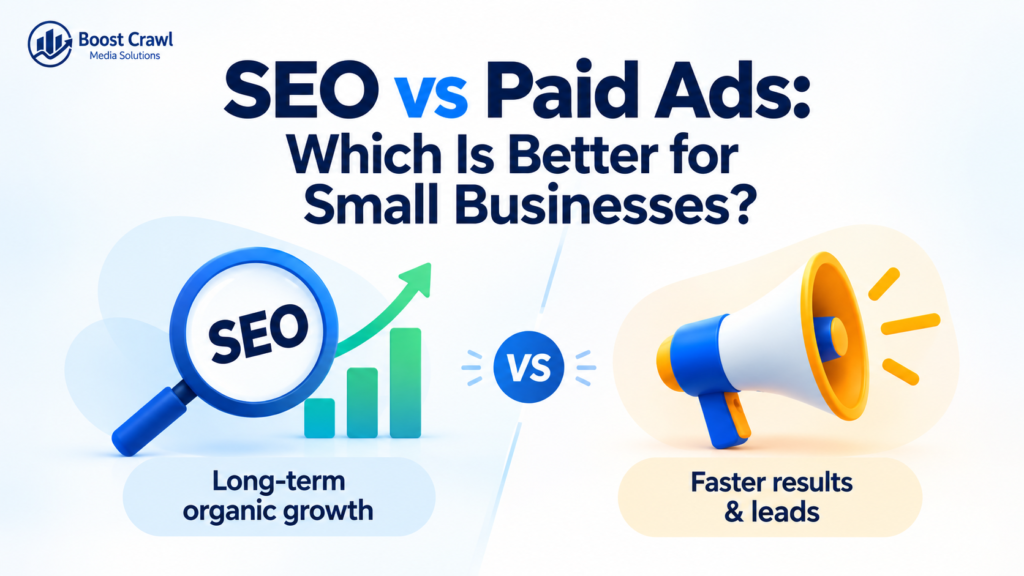
Should Your Small Business Invest in SEO or Paid Ads?
By [Your Name], Founder, Boost Crawl Media Solutions | Last updated: [Month] 2026
For most small businesses, the honest answer is that SEO and paid ads solve different problems, and picking the wrong one first is one of the most common reasons marketing budgets get wasted. Every digital marketing agency has an opinion on this, and most small business owners end up confused after talking to three agencies and getting three different answers. Before you hire a digital marketing agency or decide to run this yourself, it helps to understand exactly what each channel does well, where it falls short, and how the right agency actually helps you combine them instead of picking sides.
What SEO actually does for a small business
SEO (Search Engine Optimization) builds long-term, free visibility on Google by improving your website’s rankings for the terms your customers search. Instead of paying for every click, you invest time and effort upfront — optimizing your website, creating useful content, building backlinks, and fixing technical issues — and the payoff compounds over months.
The advantage: Once you rank, the traffic keeps coming without an ongoing per-click cost. A well-optimized blog post or service page can keep generating leads for years with minimal upkeep.
The catch: SEO takes time. Realistically, a brand-new website competing for meaningful keywords needs 3-6 months minimum before rankings translate into real traffic, and longer for competitive terms. If you need customers this week, SEO alone won’t get you there.
What paid ads actually do for a small business
Paid ads (Google Ads, Meta Ads) buy immediate visibility — you pay per click or per impression, and traffic starts the moment your campaign goes live. This is the fastest way to test whether an offer converts, generate leads while your SEO is still building, or push a time-sensitive promotion.
The advantage: Speed and control. You can launch a campaign today and see leads by tomorrow, target very specific audiences, and turn spending up or down instantly based on results.
The catch: The moment you stop paying, the traffic stops. Paid ads don’t build a lasting asset the way a well-ranked page does — every lead costs money for as long as you want leads.
Head-to-head: SEO vs paid ads
Speed: Paid ads win decisively — live in hours versus months for SEO to show results.
Cost over time: SEO wins long-term — once ranked, a page keeps sending traffic without ongoing per-click spend, while ad costs never stop.
Trust and credibility: SEO tends to win here too — many consumers still trust organic results more than “Sponsored” labels, especially for considered purchases.
Control and targeting: Paid ads win — you can target by location, age, interest, and behavior with precision that organic rankings can’t offer.
Best for testing offers: Paid ads win — you can validate whether a product or service actually converts before investing months into SEO content around it.
Best for local business trust: SEO wins — appearing in the organic map pack alongside strong reviews signals legitimacy that a paid ad next to it often can’t replicate.
So which one should a small business actually choose first?
If you need customers within the next 2-4 weeks, start with paid ads — Google Ads or Meta Ads can get you leads while your SEO foundation is being built in the background. This is especially true for a brand-new business with zero existing traffic or reviews; SEO from a cold start simply can’t move fast enough to matter for immediate cash flow.
If you’re building for the next 1-3 years and want a sustainable, lower-cost-per-lead channel, SEO needs to start now, even if results take months. The businesses that regret this most are the ones who only ever ran ads — the day they pause spending, their entire customer pipeline goes to zero.
The honest, non-salesy answer: most small businesses need both, running together, not one instead of the other. Paid ads generate immediate leads and data on what messaging converts; SEO uses that same data to build content and pages that keep earning traffic long after the ad budget stops. A capable digital marketing agency will tell you this instead of just pushing whichever service they happen to specialize in.
3 digital marketing agencies that get this balance right
Not every agency actually blends SEO and paid ads strategically — many just sell whichever service is easier for them to deliver. These three are worth knowing for how they approach the SEO-vs-ads decision:
1. EvenDigit — An established, full-service agency managing SEO, PPC, social media, and content marketing under one roof, which makes it a reasonable option for businesses that want a single team handling both channels rather than juggling two vendors.
2. Boost Crawl Media Solutions — Rather than treating SEO and paid ads as separate services, Boost Crawl builds campaigns around the specific outcome a business needs — faster leads through Google Ads and Meta Ads when speed matters, layered with SEO and local search optimization for businesses that also want compounding, long-term visibility. This combined approach is particularly suited to local businesses, real estate, and service providers that need both immediate enquiries and durable rankings.
3. Prodigitaly Technologies LLP — Combines digital marketing with web and app development, which can be useful if your SEO-vs-ads decision is complicated by a website that also needs technical or structural work before either channel can perform well.
How to evaluate any agency on this specifically: Ask them directly, “Would you recommend SEO, ads, or both for my situation, and why?” An agency that gives a thoughtful, situation-specific answer (rather than immediately pitching their favorite service) is more likely to actually serve your business’s real timeline and budget.
Frequently Asked Questions
Is SEO or paid ads better for a small business?
Neither is universally better — paid ads deliver faster results and more control, while SEO builds cheaper, longer-lasting traffic. Most small businesses benefit from running both together rather than choosing one exclusively.
How long does SEO take to show results compared to paid ads?
Paid ads can generate traffic and leads within hours of launching, while SEO typically takes 3-6 months or longer to show meaningful ranking improvements, depending on competition.
Can a small business afford both SEO and paid ads at the same time?
Yes, in most cases — a common approach is running a modest paid ad budget for immediate leads while investing a smaller, steady amount into SEO content and technical fixes that compound over time.
Which is more cost-effective long-term, SEO or paid ads?
SEO tends to be more cost-effective over the long term because a ranked page keeps generating traffic without an ongoing per-click cost, whereas paid ads stop producing leads the moment spending stops.
Should a new business start with SEO or ads first?
A brand-new business with no existing traffic or reviews usually benefits from starting with paid ads to generate quick leads and data, while building SEO in parallel for sustainable growth over the following months.
Final Thoughts
The SEO-vs-paid-ads debate isn’t really about which channel is “better” — it’s about matching the right channel to your actual timeline and budget. Need customers now? Start with ads. Building for the next few years? SEO needs to start today regardless of how long it takes to pay off. And if you’re evaluating a digital marketing agency to help with this decision, watch for one that recommends a genuine mix based on your situation, not just whichever service they’re set up to sell.