

Meta Andromeda Update: How AI Is Changing Facebook & Instagram Advertising
Digital advertising is becoming increasingly dependent on artificial intelligence, automation, and machine learning. For businesses working with a digital marketing agency in Indore, understanding how Meta’s advertising technology is evolving can help them make better decisions about Facebook and Instagram advertising. One of Meta’s major developments is Andromeda, its next-generation personalized ads retrieval engine designed to improve how relevant ads are selected from millions of possible advertisements before they are shown to users.
Meta officially detailed Andromeda in December 2024. Rather than being simply another Ads Manager feature or targeting option, Andromeda works deep inside Meta’s advertising recommendation infrastructure. It uses advanced machine learning to identify potentially relevant ads more efficiently and feed them into later stages of Meta’s ranking system.
What Is Meta Andromeda?
Whenever someone opens Facebook or Instagram, Meta has potentially millions of advertisements that could be shown to that person. The platform cannot fully analyze every available advertisement using its most computationally expensive models.
This is where ad retrieval becomes important.
Retrieval is the first stage of Meta’s multi-stage advertising recommendation system. Meta says this stage reduces tens of millions of potential ad candidates to a few thousand relevant candidates. More advanced ranking systems then evaluate those candidates to determine which advertisements should actually appear.
Andromeda is designed to make this retrieval process more intelligent, scalable, and personalized.
It uses deep neural networks, hierarchical indexing and specialized AI hardware including NVIDIA Grace Hopper technology and Meta’s own MTIA infrastructure. According to Meta, Andromeda significantly increases the capacity of its retrieval models while allowing the system to process enormous numbers of ads efficiently.
Why Did Meta Develop Andromeda?
Meta advertising has changed considerably over the years.
Previously, advertisers often depended heavily on detailed audience targeting, numerous audience segments and manual campaign structures. Today, Meta increasingly uses AI and automation through products such as Advantage+.
At the same time, advertisers can create many more variations of ads through dynamic creative and generative AI tools.
This creates a major technical challenge: Meta has more potential ads to evaluate while users still expect relevant content almost instantly.
Andromeda was developed to help solve this problem by allowing Meta’s systems to efficiently identify potentially relevant advertisements from a much larger pool of creatives.
For advertisers involved in performance marketing in Indore, or running campaigns anywhere else, this shift highlights an important change: providing Meta with strong creative options, accurate conversion data and clear campaign objectives is becoming increasingly important as AI handles more of the matching process.
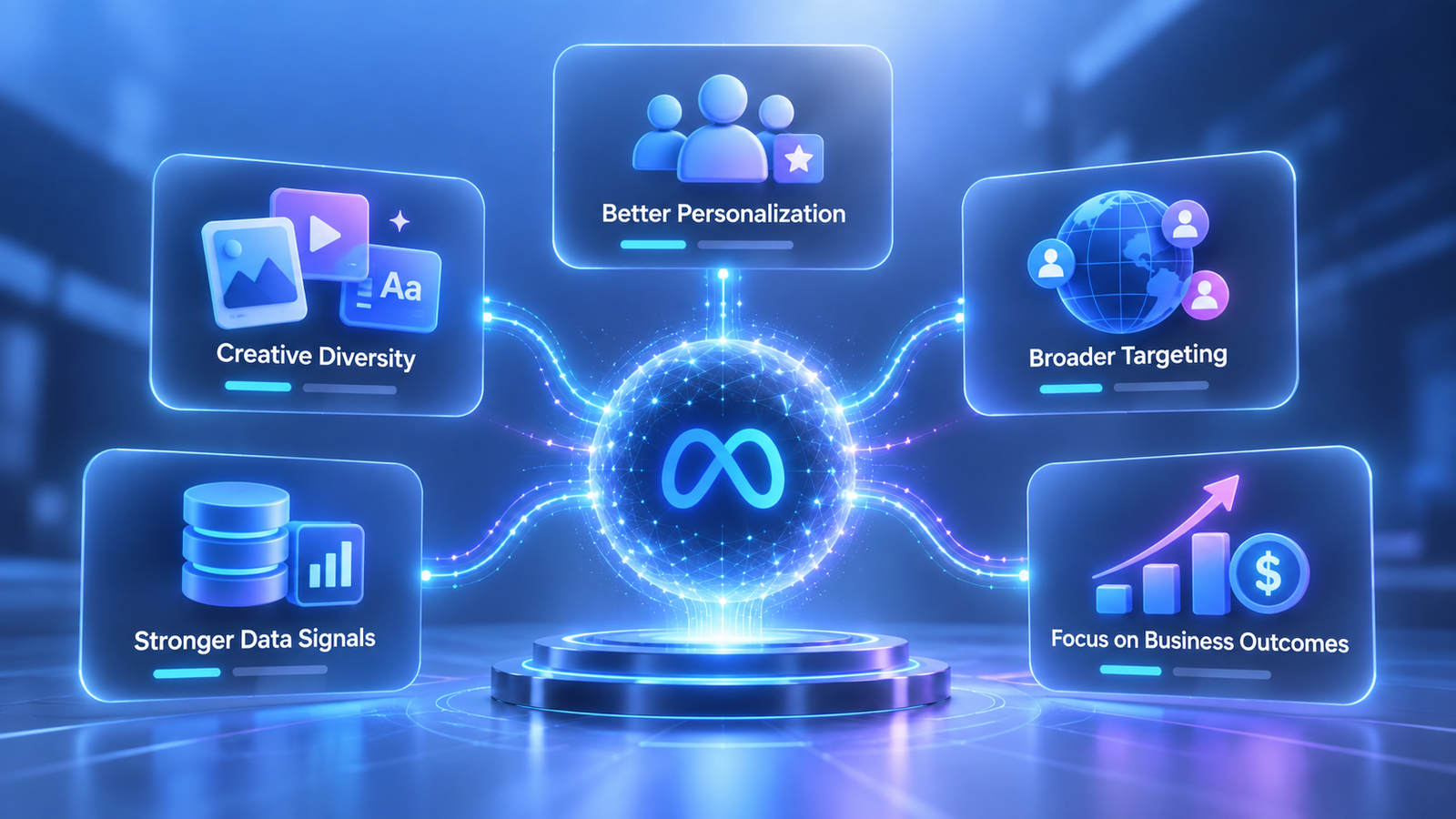
6 Key Ways Andromeda Changes the Meta Advertising Landscape
1. More Advanced Ad Personalization
Andromeda is designed to better understand relationships between users, advertisements, products and interests.
Rather than relying only on manually engineered rules, Meta can use larger neural networks to identify complex patterns and determine which advertisements may be most relevant for different users.
Meta reported a 6% improvement in retrieval recall and an 8% improvement in ads quality on selected segments following deployment across Facebook and Instagram.
2. Creative Diversity Becomes More Important
Advertisers should pay increasing attention to creative strategy.
Instead of repeatedly running almost identical ads, businesses can test different creative concepts based on customer pain points, benefits, demonstrations, testimonials, offers and use cases.
Andromeda’s architecture was specifically designed to handle the rapidly increasing volume of advertising creatives generated through automation and generative AI.
That does not mean advertisers should create hundreds of meaningless variations. The objective should be meaningful creative diversity.
3. Broad Targeting Can Work With Strong Signals
Advertisers traditionally spent significant time manually defining interests and audience combinations.
Meta’s broader direction is toward predictive targeting and automation, where its systems have greater freedom to identify people who may respond to an advertisement.
Andromeda strengthens the technology behind that approach by improving Meta’s ability to retrieve relevant ads from enormous pools of candidates.
Therefore, businesses should avoid assuming that increasingly narrow targeting will always produce better results.
4. Campaign Data Matters More Than Ever
Artificial intelligence performs better when it receives useful signals.
Meta campaigns should therefore be supported by proper tracking whenever appropriate, such as the Meta Pixel, Conversions API and clearly defined conversion events.
For an e-commerce business, the important event could be a purchase. For real estate, it could be a qualified lead. For a service business, it could be a booked appointment or enquiry.
The advertiser still needs to tell Meta what business outcome matters.
5. Creative Strategy and Media Buying Are Becoming Connected
There used to be a clearer distinction between the person designing advertisements and the person managing campaigns.
AI-driven advertising is reducing that separation.
Media buyers need to understand creative performance, while creative teams need to understand advertising data.
A campaign may need different messages for users experiencing different problems or demonstrating different levels of intent. Providing those variations gives Meta more opportunities to find an appropriate advertisement for each user.
6. Marketers Should Focus More on Business Outcomes
Automation does not eliminate the role of marketers.
It changes where marketers should spend their time.
Instead of constantly making small manual targeting changes, marketers can focus more on understanding customers, analyzing offers, improving landing pages, producing better creatives, measuring lead quality and interpreting business results.
AI can help determine who sees an advertisement, but it cannot automatically fix a weak offer or poor customer experience.
What Should Advertisers Do After Andromeda?
Businesses do not need to search Ads Manager for an “Andromeda” button. It is part of Meta’s underlying advertising infrastructure rather than a separate campaign objective that advertisers manually activate.
Instead, advertisers can adapt to the broader AI-driven direction of Meta Ads.
Develop several genuinely different creative concepts. Give each advertisement a clear message and objective. Avoid over-segmenting audiences without evidence that segmentation improves performance. Use accurate tracking and conversion signals. Analyze results based on meaningful business metrics such as qualified leads, cost per acquisition and return on ad spend rather than focusing only on clicks or impressions.
Testing should also remain systematic.
If five creatives are performing differently, marketers should study why they are different. The winning insight could be the hook, customer problem, product demonstration, offer or format—not simply the design.
Does Andromeda Mean Targeting Is Dead?
No.
Targeting still matters, particularly where businesses have geographical restrictions, age requirements, customer lists or other genuine audience constraints.
However, the balance between manual targeting and algorithmic matching is changing.
Meta is investing heavily in systems capable of predicting relevance and matching advertisements with users automatically. Andromeda represents an important piece of that technology.
Advertisers therefore need to think beyond simply asking, “Which interest should I target?”
A better set of questions is:
Who is my customer? What problem are they trying to solve? What message will attract their attention? What evidence will build trust? What action do I want them to take?
Final Thoughts
Meta Andromeda represents a broader transformation taking place across digital advertising. AI is moving from being an optional marketing tool to becoming part of the infrastructure deciding how advertisements are retrieved, ranked and delivered.
For businesses, the opportunity is not simply to automate everything. The real opportunity is to combine Meta’s increasingly sophisticated AI with strong human marketing fundamentals.
Customer research, positioning, offers, creative strategy, conversion tracking and continuous testing remain essential.
The advertisers that understand both sides—the human psychology behind purchasing decisions and the AI systems behind ad delivery—will be better equipped to build efficient and scalable Meta advertising campaigns.